
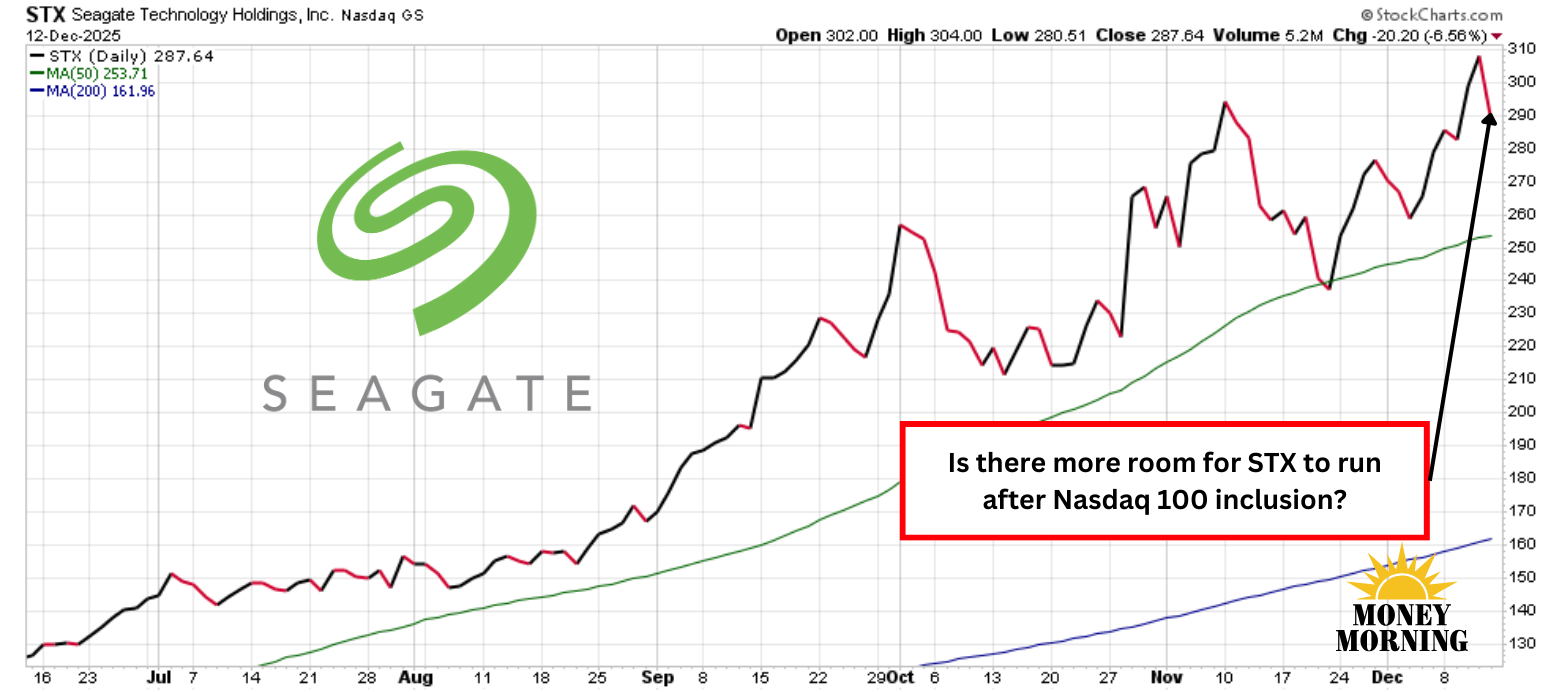
Seagate Technology (STX) has been a standout performer in the S&P 500 this year, with shares roughly tripling in value in 2025, delivering year-to-date gains of 233%.
Only Western Digital (WDC) – its direct competitor in hard disk drives (HDD) – and the newly spun-off SanDisk (SNDK), a flash memory pure-play, have posted stronger returns among large-cap stocks.
This remarkable rally has propelled STX into the spotlight, culminating in a major milestone: On Friday, Nasdaq announced Seagate will join the Nasdaq-100 Index as part of its annual reconstitution, with inclusion becoming effective Dec. 22. The addition alongside peers like Western Digital and four other stocks underscores the growing recognition of data storage leaders in the tech ecosystem.
For investors, the question is, has this explosive run left STX overextended, meaning latecomers have missed the boat? Or does the stock still have meaningful upside as AI-driven demand accelerates?
 The AI Storage Boom Fuels Seagate’s Outperformance
Seagate’s surge has outpaced not just megacap tech giants like Nvidia (NVDA) and Palantir Technologies (PLTR) – which have delivered strong but comparatively modest gains amid broader AI enthusiasm – but nearly every other S&P 500 constituent. The key driver has been explosive demand for high-capacity HDDs in AI data centers.
While most attention has focused on GPUs and semiconductors, the reality is that training and running large language models generate massive datasets requiring cost-effective, high-density storage. Cloud hyperscalers like Amazon (AMZN), Microsoft (MSFT), and Google are rapidly expanding infrastructure, prioritizing nearline and mass-capacity HDDs for archival and bulk storage needs.
Seagate, as a leading HDD manufacturer, has been a direct beneficiary, reporting robust revenue growth – up over 30% in recent quarters – and sharply improved margins from disciplined pricing and supply management.
Unlike flash-based SSDs, which dominate in speed-critical applications, HDDs excel in cost per terabyte for petabyte-scale storage, making them indispensable for AI workloads. Seagate’s fiscal 2025 results reflected this shift, with enterprise and cloud segments driving the bulk of gains. Strong guidance and analyst upgrades further fueled momentum, as investors recognized storage as an underappreciated “picks and shovels” play in the AI gold rush.
This structural tailwind has allowed STX to eclipse pure software AI names like PLTR and even chip leaders, highlighting how infrastructure hardware is capturing a larger share of AI spending.
Index Inclusion and Passive Inflows Ahead
The Nasdaq-100 addition is timely, expected to trigger significant buying from index-tracking funds like Invesco QQQ Trust ETF (QQQ), which manage hundreds of billions in assets. Historical precedents show additions often enjoy short-term boosts from forced inflows, potentially providing another catalyst for STX.
Combined with ongoing cloud capex cycles, this positions Seagate favorably heading into 2026.
Bottom Line
STX has not run its course – there’s still room for the next leg higher. Trading around 19x forward earnings with a PEG ratio of roughly 0.73 (based on consensus five-year EPS CAGR estimates near 27%), the stock remains attractively valued relative to its growth prospects.
AI data explosion shows no signs of slowing, even as concerns about its sustainability grow. Seagate’s market leadership in mass-capacity storage should sustain elevated demand. While volatility is likely in cyclical hardware, current metrics suggest STX is cheap for its trajectory. Investors can reasonably buy Seagate, eyeing potential re-rating as earnings visibility increases.
— Rich Duprey
$3 billion+ in operating income. Market cap under $8 billion. 15% revenue growth. 20% dividend growth. No other American stock but ONE can meet these criteria... here's why Donald Trump publicly backed it on Truth Social. See His Breakdown of the Seven Stocks You Should Own Here.
Source: Money Morning