
Since returning to office, the Trump administration has moved aggressively to rebuild U.S. leadership in foundational industries. From domestic semiconductor fabrication, battery materials, rare-earth processing, and advanced manufacturing, it has invested billions in companies to reduce reliance on overseas supply chains and counter China’s growing influence.
The latest frontier is arguably the most critical of all: extreme ultraviolet (EUV) lithography, the irreplaceable technology that enables the world’s most advanced AI chips. For more than two decades, Dutch firm ASML (ASML) has enjoyed a near-total monopoly on EUV systems, shipping multi-hundred-million-dollar machines that are the only tools capable of printing transistors at 3 nm and below.
With AI training clusters demanding ever-denser silicon and geopolitical export controls squeezing sales to China, Washington has decided the status quo is no longer acceptable. The administration is now targeting the one corner of the chip stack where the U.S. still has zero domestic capability – and that has put ASML directly in the crosshairs
A New Player Emerges
xLight is a promising U.S. startup that just secured up to $150 million in federal funding from the Trump administration in exchange for a stake in the company that makes the government its largest shareholder.
Founded in 2024 it positions itself not as a direct ASML killer, but as a strategic enhancer. With backing from venture firm Playground Global, xLight is laser-focused on revolutionizing light sources for lithography.
At its core, it is pioneering free-electron lasers powered by compact particle accelerators, aiming for wavelengths as fine as 2 nanometers – far surpassing ASML’s current 13.5 nm standard. This innovation promises to slot seamlessly into existing ASML systems, allowing upgrades without full overhauls. By potentially doubling transistor densities biennially and cutting wafer processing costs by 30% to 40%, xLight could slash energy use in fabs, making AI hardware more efficient and affordable.
Production of initial silicon wafers is targeted for 2028, a timeline that underscores the tech’s ambition amid challenges like scaling accelerators beyond lab prototypes.
 Collaboration Over Confrontation
Executive Chairman Pat Gelsinger, Intel (INTC) former CEO who was unceremoniously ousted in 2024, has been vocal about xLight’s partnership potential, including with ASML. Having pitched the concept directly to Commerce Secretary Howard Lutnick earlier this year, Gelsinger envisions xLight’s tech “reviving Moore’s Law from its nap” by complementing ASML’s ecosystem. Rather than building standalone machines, xLight seeks to integrate its superior light sources into ASML’s proven platforms, accelerating R&D and easing U.S. fabs’ path to sub-2 nm nodes.
This collaborative bent aligns with broader industry needs: ASML’s $300 billion order backlog reflects insatiable AI-driven demand, but export restrictions to China cloud its 2026 growth. xLight’s advancements could mitigate these by boosting throughput and efficiency, indirectly fortifying ASML’s position against any true disruptors. Gelsinger’s track record in semiconductor scaling adds credibility, hinting at alliances that turn rivals into allies.
Bottom Line
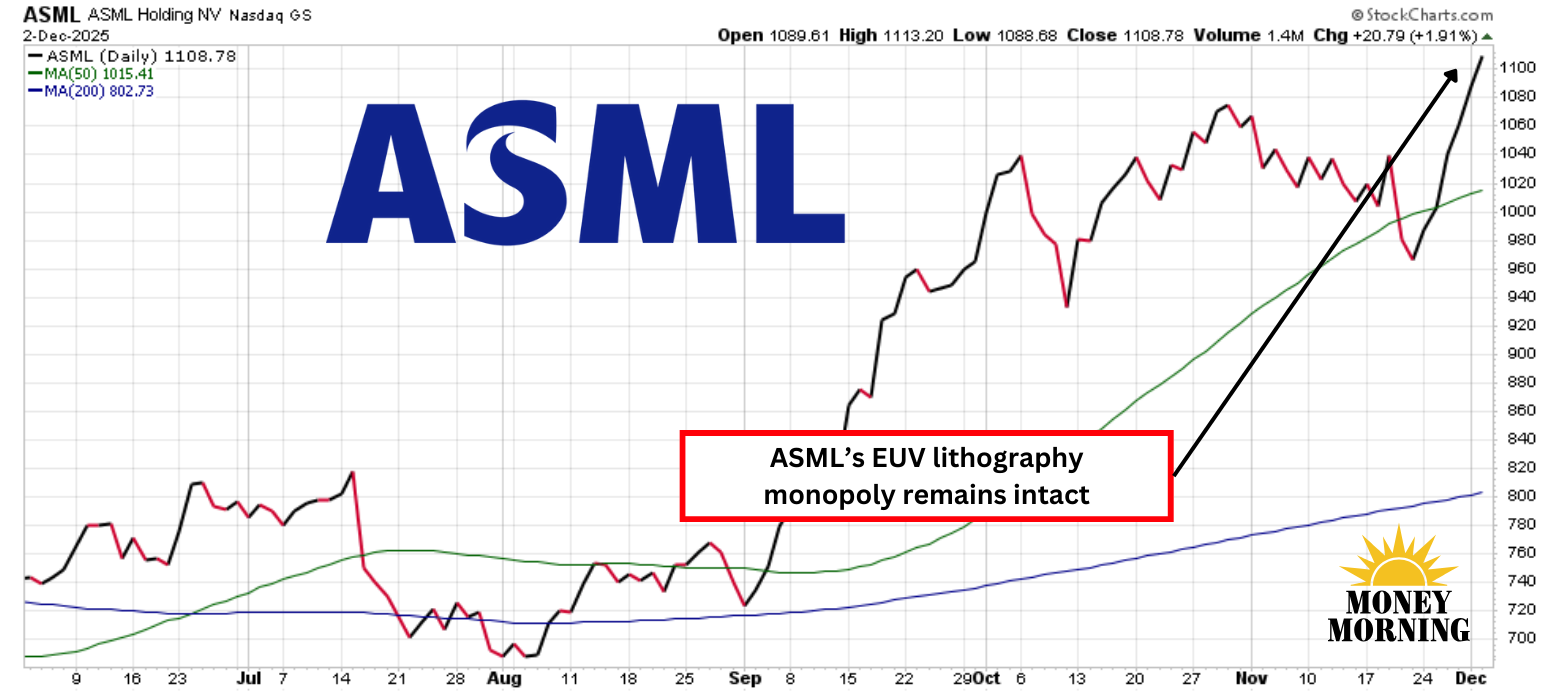
ASML’s iron grip on EUV lithography remains secure for the foreseeable future, underpinned by decades of IP and a booming AI market that forecasts 15% growth in 2025. With no immediate scalable threats, the company’s prospects look robust, even as China sales dip.
xLight, if it delivers on its 2028 milestone, could prove beneficial – supercharging ASML’s machines, lowering costs, and extending Moore’s Law to fuel next-gen AI. Far from eroding the monopoly, this upstart might just amplify it, ushering in an era of collaborative innovation that benefits all stakeholders.
— Rich Duprey
$3 billion+ in operating income. Market cap under $8 billion. 15% revenue growth. 20% dividend growth. No other American stock but ONE can meet these criteria... here's why Donald Trump publicly backed it on Truth Social. See His Breakdown of the Seven Stocks You Should Own Here.
Source: Money Morning