
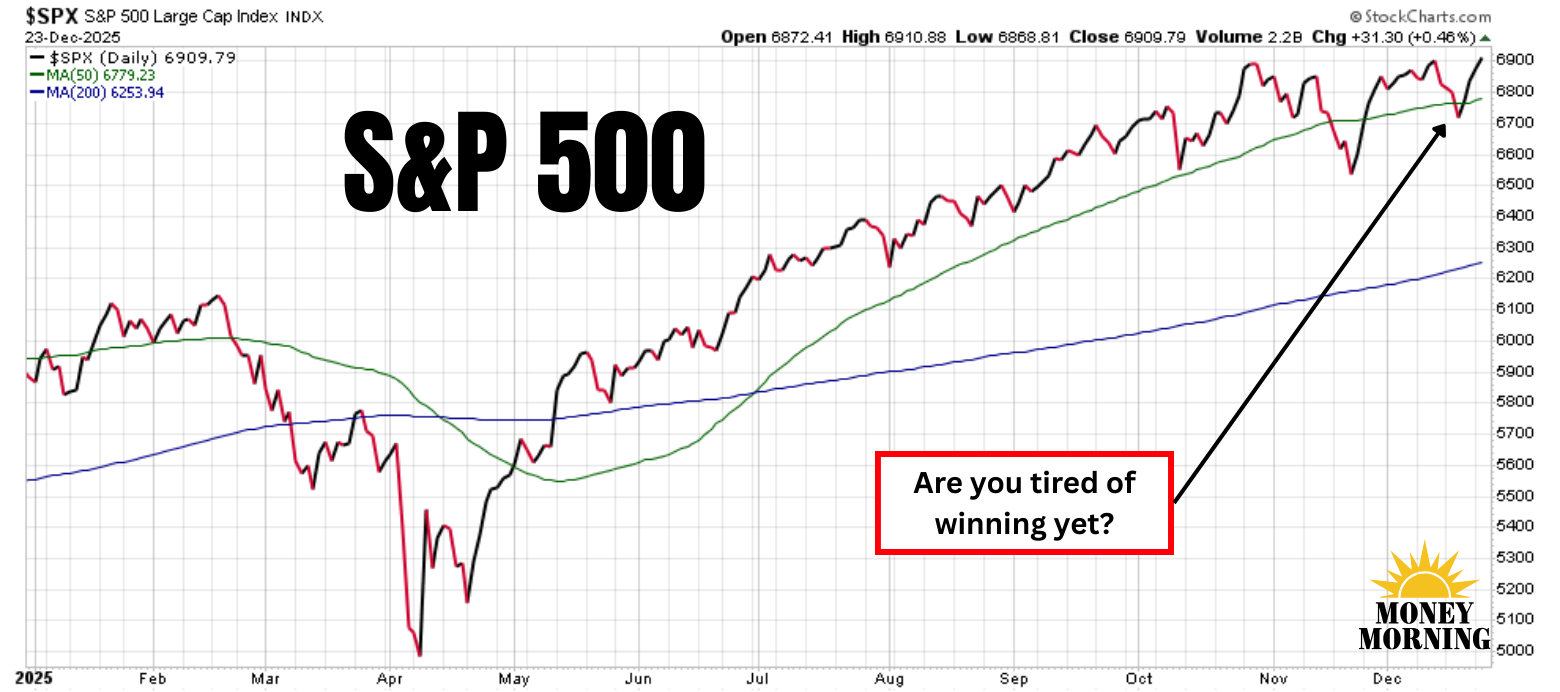
The S&P 500 is on track to deliver its third consecutive year of double-digit gains. Year-to-date, the broad market index is up 19%, including reinvested dividends, a rare streak seen only about 11 times in the past century. It builds on the 26% in total returns seen in 2023 and the 25% gains in 2024.
This ongoing momentum – reinforced by strengthening market breadth and momentum signals – sets the stage for yet another year of double-digit returns in 2026, extending the run to four years. Only in the 1990s when the streak ran for an unprecedented five years has this occurred.
A Rare Signal of Market Breadth
A prominent bullish development this past summer was the notable expansion in market breadth. Cyclical sectors, including industrials, materials, and consumer discretionary, witnessed a substantial number of stocks rising above their 200-day moving averages. Historically, when over 75% of stocks in these sectors exceed this level, it has reliably predicted strong S&P 500 advances.
This particular setup – occurring for only the 15th time since 1953 – has been followed by average 12-month gains of roughly 29%, with a flawless record of success in prior occurrences. The change signified broader rally participation beyond just the dominant mega-cap technology stocks, offsetting earlier concentration risks.
Complementing this, small-cap indexes like the Russell 2000 displayed periods of leadership over large caps, indicating solid economic foundations in manufacturing and consumer sectors. Over the past month, the small-cap index is beating its large-cap peer by 55%.
 Historical Precedents and Long-Term Durability
Periods of three or more double-digit gain years for the S&P 500 are scarce yet, when they occur, they frequently prolong or produce strong subsequent performances, particularly with widening breadth over narrow leadership. Back-dated data supports this view: from 1900 onward, all 10- and 20-year rolling periods have delivered positive returns including dividends, including through world wars, the Great Depression, recessions, and global pandemics.
As 2025 comes to a close, the S&P 500 trades around 6,900, securing another double-digit year. It’s quite possible that over the next week, the index will break above 20% gains. The market’s breadth of improvement underscores the potential for further double-digit gains in 2026, assuming no extreme external shocks.
Factors including Federal Reserve interest rate cuts, consistent corporate earnings growth, and ongoing productivity boosts from technological advancements support the argument for another big year. Though valuations stand above historical norms, they are built on a foundation of growth and controlled inflation.
Moreover, consecutive years of outsized performance often reflect a maturing bull market where participation expands, reducing risks of abrupt reversals. When market breadth signals align with new all-time highs in stock prices, forward returns have typically remained robust, rewarding disciplined allocation.
Bottom Line
Despite the S&P 500 at record levels, investors should maintain stock exposure. The simplest path is to by ETFs that mimic the index, such as the Vanguard S&P 500 ETF (VOO) or even the Vanguard Total Stock Market ETF (VTI).
With every 10- and 20-year interval showing gains – underscoring the risks of market timing – maintaining a presence in the market allows for capturing the benefits of compounding in this prolonged bull cycle.
— Rich Duprey
$3 billion+ in operating income. Market cap under $8 billion. 15% revenue growth. 20% dividend growth. No other American stock but ONE can meet these criteria... here's why Donald Trump publicly backed it on Truth Social. See His Breakdown of the Seven Stocks You Should Own Here.
Source: Money Morning