
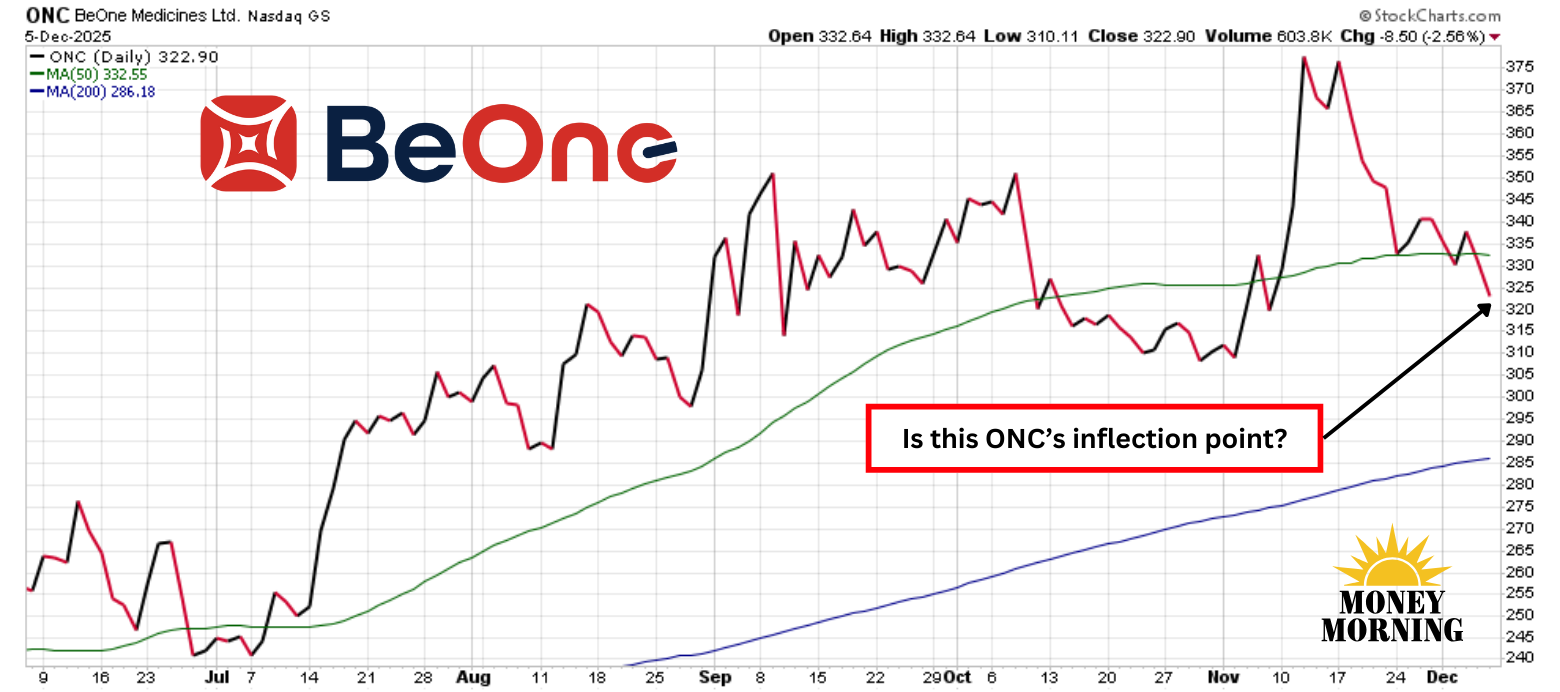
Swiss oncology powerhouse BeOne Medicines (ONC) has emerged as one of 2025’s top performers in a sector often plagued by volatility. Year-to-date, ONC shares have rocketed 75%, outpacing many peers amid renewed investor enthusiasm for oncology innovations. Yet, the stock has retreated 16% from its November peak, trading around $323 per share as broader market jitters cool the rally.
Specializing in targeted therapies for hematologic and solid tumors, ONC stands out through its dual focus on BTK inhibitors (BTKi) like Brukinsa and PD-1 inhibitors like Tevimbra, blending precision medicine with immunotherapy. Unlike larger rivals burdened by diversified portfolios, ONC’s oncology-focused pipeline – bolstered by strategic partnerships in Asia and a prolific early-stage slate – delivers outsized growth potential with lower overhead.
While 2025 has been a phenomenal year for the biotech, 2026 could be even better.
China Delivers the Next Catalyst
The broader biotech sector has enjoyed a robust rebound since hitting lows in April, fueled by favorable FDA approvals, M&A buzz, and easing interest rates that unlocked capital for innovation-starved firms.
ONC has led the charge, propelled by Brukinsa (zanubrutinib), its blockbuster BTKi therapy for lymphomas and leukemias, which now accounts for nearly three-quarters of the company’s 2025 sales at $2.7 billion. This milestone drug, approved in over 75 countries, has driven consistent revenue beats, with Q3 results showing 51% year-over-year growth to $1 billion.
Just this month, ONC notched another key milestone: inclusion on China’s inaugural private insurance drug catalog, a game-changer for global pharma.
This first-of-its-kind list features 19 high-cost innovative medicines too pricey for the national reimbursement scheme but now eligible for coverage by commercial insurers. Heavyweights like Eli Lilly (LLY), Pfizer (PFE), and Johnson & Johnson (JNJ) also landed spots for their cancer therapies, alongside domestic CAR-T players.
For these companies, the catalog means expanded reimbursement at negotiated discounts of 15% to 50%, shielding margins from the state’s aggressive price cuts while tapping China’s burgeoning private insurance market – now covering 400 million people amid an aging population. It shifts pricey treatments from out-of-pocket burdens to insured access, potentially boosting sales by 20% to 30% in the near term.
 BeOne Stands Out
ONC holds a unique distinction here: it is the only firm with two drugs added to the list – Brukinsa and Tevimbra (tislelizumab). Though Tevimbra trails far behind as ONC’s second-biggest drug with only $555 million in 2025 sales, both are already commercialized in China via local partnerships.
Brukinsa’s mantle-cell lymphoma indication alone commands a $5 billion addressable market in the world’s second-largest pharma economy, where non-Hodgkin lymphoma cases are surging 5% annually. Tevimbra, targeting esophageal and lung cancers, eyes $2 billion in untapped potential.
Inclusion in the list supercharges this opportunity: private coverage could double patient uptake, with Brukinsa poised for the lion’s share of gains due to its frontline status. Analysts now forecast 15% sales growth for ONC in 2026, versus 8% sector-wide.
Bottom Line
ONC’s stock pullback offers investors a compelling entry into this high-octane biotech, now valued at 6x forward sales – a premium even after the pullback, but reflecting its 25% projected CAGR through 2028.
With China’s private channel unlocking Brukinsa’s full potential and Tevimbra offering sleeper upside, BrOneMedicines is positioned to hit new highs in 2026. It makes ONC a surefire bet for risk-tolerant portfolios.
— Rich Duprey
$3 billion+ in operating income. Market cap under $8 billion. 15% revenue growth. 20% dividend growth. No other American stock but ONE can meet these criteria... here's why Donald Trump publicly backed it on Truth Social. See His Breakdown of the Seven Stocks You Should Own Here.
Source: Money Morning